AtoZmat — Advanced Materials from A to Z
Abstract
Barium titanate (BaTiO₃) sputtering targets are a critical enabler for high-performance dielectric and ferroelectric thin films used in multilayer ceramic capacitors (MLCCs) and ferroelectric random-access memory (FeRAM). This review covers target manufacturing, sputtering protocols, film characterization, and the link between process parameters and ultimate device performance. As electronics continue to shrink while demanding higher functionality, sputtered BaTiO₃ films are becoming indispensable for next-generation capacitors and non-volatile memories.
1. What is BaTiO₃?
BaTiO₃ is a prototypical perovskite-structured ferroelectric whose dielectric constant spans 1,000–10,000 in bulk, exhibits low loss, and retains switchable polarization at room temperature. These traits make it the dielectric of choice for MLCCs and a lead-free candidate for FeRAM. Sputtering has emerged as the most reproducible route to stoichiometric, nanometer-thin BaTiO₃; the quality of the target dictates the quality of the film.
2. Target Fabrication
2.1 Material Requirements
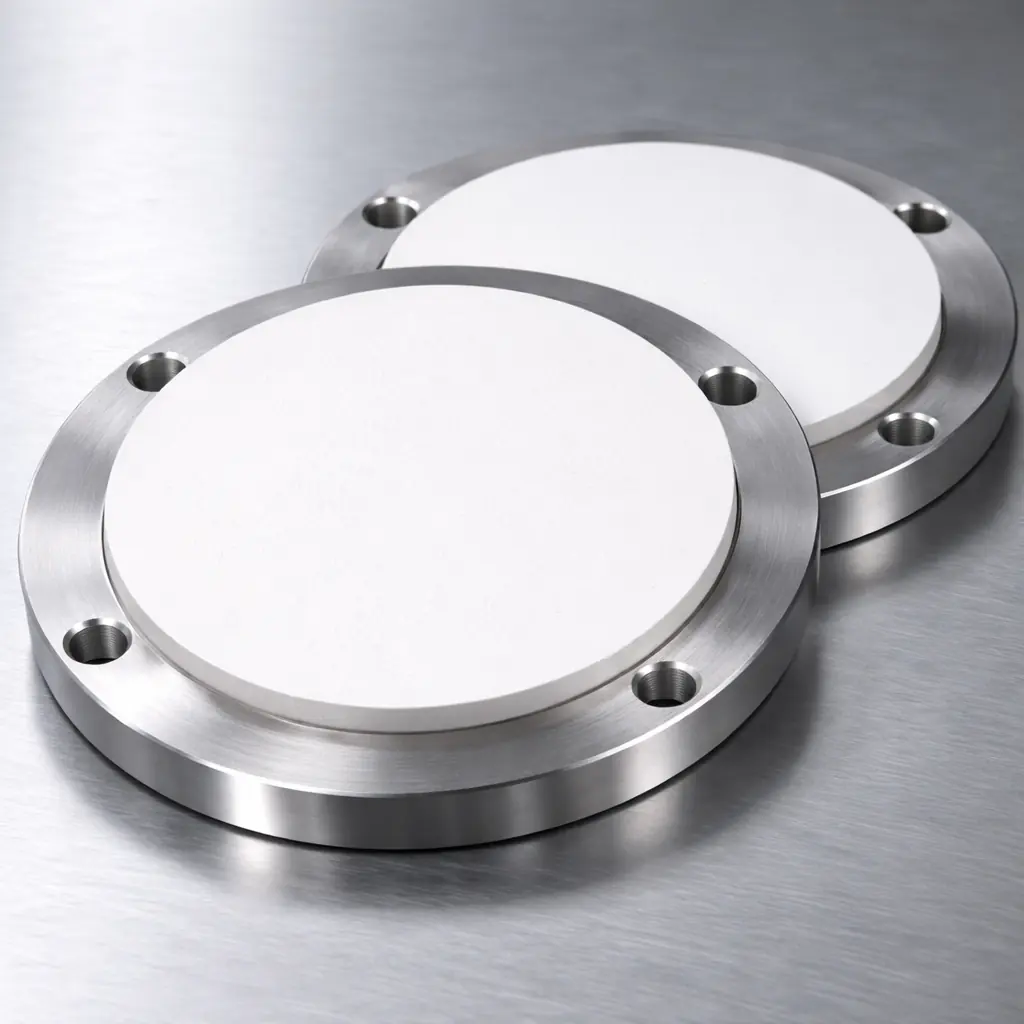
- > 95 % theoretical density (arcing suppression)
- Uniform, sub-micron grain size
- Exact 1 : 1 Ba : Ti ratio
- < 100 ppm total impurities
- Adequate flexural strength for thermal cycling
2.2 Process Flow
- Powder synthesis: solid-state, hydrothermal, or sol-gel routes.
- Green forming: cold-isostatic pressing, uniaxial pressing, or slip-casting.
- Sintering: 1,200–1,400 °C in oxygen-rich atmospheres to suppress oxygen vacancies.
- Machining: diamond-turn to final dimensions and surface finish (Ra < 0.5 µm).
3. Sputtering Techniques
3.1 RF Magnetron Sputtering
Industry work-horse; delivers uniform, adhesive films at ≤ 700 °C substrate temperature.
(Nagatomo et al., 1981)
3.2 Reactive Sputtering from Metal Targets
Co-sputtering Ba and Ti in an Ar/O₂ plasma allows real-time stoichiometry tuning and lower target cost.
(Osumi et al., 2012)
3.3 Key Parameters
| Parameter | Typical Window | Effect |
|---|---|---|
| Tsub | 550–750 °C | Tetragonality, orientation |
| Pwork | 2–6 Pa | Density, stress |
| Ar/O₂ | 80/20–95/5 | Oxygen vacancies, leakage |
| PRF | 100–300 W | Rate, ion bombardment |
4. Film Properties
4.1 Structural
XRD shows single-phase perovskite with (111) or (110) texture depending on Tsub.
4.2 Dielectric
εr ≈ 630, tan δ ≈ 0.02 @ 10 kHz for 300 nm films deposited at 625 °C / 4.5 Pa.
(He et al., 2013)
4.3 Ferroelectric
Well-saturated P-E loops, 2Pr ≈ 8–12 µC cm⁻², Ec < 50 kV cm⁻¹, > 10⁹ fatigue cycles.
(Sharma & Negi, 2018)
5. MLCC Applications
5.1 Market Drivers
- Thinner dielectrics (< 1 µm)
- Higher capacitance per unit volume
- Ni-electrode compatibility (base-metal electrode, BME)
5.2 Sputtered Thin-Film MLCCs
RF-sputtered BaTiO₃ on Ni foils yields εr ≈ 150, tan δ ≈ 0.03, capacitance stable ±10 % from –55 to 125 °C.
(Park et al., 2005, 2008)
5.3 Coated-Ni Powder Approach
Conformal BaTiO₃ nano-shells on spherical Ni powders enable 3-D stacked BME capacitors with engineered interfaces.
(Lee et al., 2003)
6. FeRAM Applications
6.1 Cell Structure
1-transistor / 1-capacitor (1T-1C) stack; polarization up = “1”, down = “0”.
6.2 Performance Targets
- 2Pr ≥ 10 µC cm⁻²
- Ec ≤ 50 kV cm⁻¹ for 1.8 V operation
- Endurance ≥ 10¹³ cycles
- Jleak < 10⁻⁷ A cm⁻² @ 200 kV cm⁻¹
6.3 Integration Challenges
- Bottom-electrode adhesion (TiN, Pt)
- Hydrogen barrier layers during BEOL
- 3-D capacitor etch and sidewall passivation
7. Deposition Technique Comparison
| Method | Stoichiometry | Scalability | Conformality | Cost |
|---|---|---|---|---|
| Sputtering | Excellent | 300 mm wafers | Moderate | Medium |
| PLD | Excellent | Limited | Poor | High |
| MBE | Atomic | Research | Poor | Very high |
| Sol-gel | Good | Large | Good | Low |
| MOCVD | Good | 300 mm | Excellent | High |
| ALD | Atomic | 300 mm | Excellent | Medium |
8. Recent Advances & Outlook
8.1 Target Innovations
- Nanostructured, doped, and composite targets
- 450 mm monolithic targets for gigafabs
- In-situ oxygen injection for real-time stoichiometry control
8.2 Process Trends
- < 400 °C deposition for back-end-of-line (BEOL) compatibility
- In-line spectroscopic ellipsometry for closed-loop feedback
- Hybrid sputter/anneal cycles for grain-size engineering
8.3 Emerging Uses
- Embedded deep-trench decoupling capacitors
- Piezo-MEMS switches and RF filters
- Neuromorphic memristive arrays leveraging ferroelectric domain walls
8.4 Sustainability
Lead-free BaTiO₃ is RoHS-compliant. Future efforts target:
- 30 % lower sintering temperature via flash-sintering
- Target recycling by closed-loop powder recovery
- Green solvents for slip-casting binders
9. Conclusion
BaTiO₃ sputtering targets are the cornerstone of high-κ dielectric and ferroelectric thin-film manufacturing for MLCCs and FeRAM. Continued advances in target engineering, low-temperature sputtering, and CMOS-compatible integration will keep sputtered BaTiO₃ at the center of miniaturized, high-performance electronics for the coming decade.
References
- Nagatomo, T.; Kosaka, T.; Omori, S.; Omoto, O. Fabrication of BaTiO₃ Films by RF Planar-Magnetron Sputtering. Ferroelectrics 1981, 37 (1), 681–684. DOI: 10.1080/00150198108223520
- He, F.; Ren, W.; Liang, G.; Shi, P.; Wu, X.; Chen, X. Structure and Dielectric Properties of Barium Titanate Thin Films for Capacitor Applications. Ceram. Int. 2013, 39, S481–S485. DOI: 10.1016/j.ceramint.2012.10.118
- Osumi, T.; Nishide, M.; Funakubo, H.; Shima, H.; Nishida, K.; Yamamoto, T. Preparation and Characterization of BaTiO₃ Thin Films Using Reactive Sputtering Method with Metal Target. Integr. Ferroelectr. 2012, 133 (1), 42–48. DOI: 10.1080/10584587.2012.664029
- Park, S.-S. Properties of Multilayer Ceramic Capacitor with BaTiO₃ Thin Layers Deposited by E-Beam Evaporation. Integr. Ferroelectr. 2005, 74 (1), 87–94. DOI: 10.1080/10584580500413962
- Sharma, H.; Negi, N. S. Fabrication and Characterization of Lead-Free BaTiO₃ Thin Film for Storage Device Applications. AIP Conf. Proc. 2018, 1953, 100069. DOI: 10.1063/1.5033005
- Reymond, V.; Payan, S.; Michau, D.; Manaud, J.-P.; Maglione, M. Structural and Electrical Properties of BaTi₁₋ₓZrₓO₃ Sputtered Thin Films: Effect of the Sputtering Conditions. Thin Solid Films 2004, 467 (1–2), 54–58. DOI: 10.1016/j.tsf.2004.03.005
- Park, S.-S.; Ha, J.-H.; Wadley, H. N. Preparation of BaTiO₃ Films for MLCCs by Direct Vapor Deposition. Integr. Ferroelectr. 2008, 99 (1), 105–113. DOI: 10.1080/10584580802107809
- Lee, J.-Y.; Lee, J.-H.; Hong, S.-H.; Lee, Y. K.; Choi, J.-Y. Coating BaTiO₃ Nanolayers on Spherical Ni Powders for Multilayer Ceramic Capacitors. Adv. Mater. 2003, 15 (19), 1655–1658. DOI: 10.1002/adma.200305418