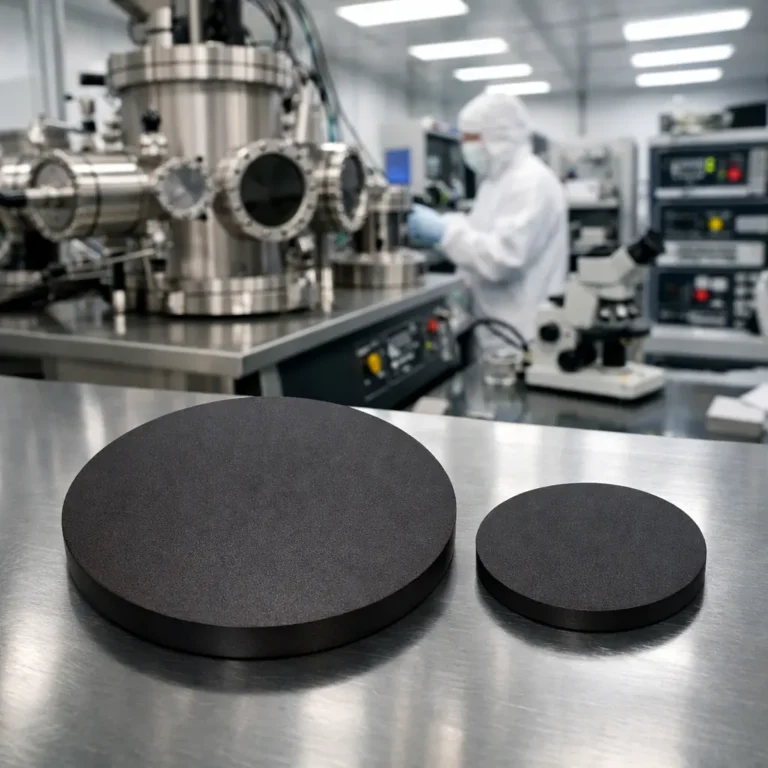
Lanthanum manganite (LaMnO3) perovskite materials have emerged as versatile functional materials with significant applications in both automotive catalytic converters and solid oxide fuel cell (SOFC) cathode films. This article comprehensively reviews the fabrication, properties, and applications of LaMnO3 sputtering targets for thin film deposition in these two critical energy and environmental technologies. The unique perovskite structure of LaMnO3 provides excellent catalytic activity for exhaust gas treatment and superior electrochemical performance for oxygen reduction reactions in SOFCs. Recent advances in sputtering target fabrication, thin film deposition techniques, and material modifications are discussed, highlighting the dual functionality of LaMnO3-based materials in addressing both emission control and clean energy generation challenges.
1. What is LaMnO3 Sputtering Target: Automotive Catalytic Converter and SOFC Cathode Films
Perovskite oxides with the general formula ABO3 have attracted considerable attention due to their diverse functional properties, including catalytic activity, electronic conductivity, and oxygen transport capabilities [1]. Among these, lanthanum manganite (LaMnO3) and its substituted derivatives represent a particularly important class of materials with applications spanning from automotive exhaust treatment to solid oxide fuel cell (SOFC) technology. The development of high-quality LaMnO3 sputtering targets has enabled the fabrication of thin films with controlled composition, microstructure, and properties for these applications [2].
The automotive industry faces stringent emission regulations requiring efficient catalytic converters to reduce pollutants such as carbon monoxide (CO), hydrocarbons (HC), and nitrogen oxides (NOx) [3]. Simultaneously, the transition to clean energy technologies has driven research into SOFCs as efficient energy conversion devices, where cathode materials play a crucial role in determining overall cell performance [4]. LaMnO3-based materials offer promising solutions for both applications due to their tunable properties through cation substitution and defect engineering.
2. LaMnO3 Perovskite Structure and Properties
LaMnO3 crystallizes in the perovskite structure with La³⁺ ions occupying the A-site and Mn³⁺ ions at the B-site in an octahedral coordination with oxygen. The perovskite structure can accommodate significant cation substitutions at both A- and B-sites, allowing for precise tuning of electronic, catalytic, and transport properties [5]. The material exhibits mixed ionic-electronic conductivity, making it suitable for both catalytic and electrochemical applications.
The oxygen non-stoichiometry in LaMnO3 (LaMnO3±δ) plays a critical role in determining its functional properties. Excess oxygen (δ > 0) creates cation vacancies and influences the Mn oxidation state, which directly affects catalytic activity and electrical conductivity [6]. The ability to control oxygen content through processing conditions and doping strategies enables optimization for specific applications.
3. Fabrication of LaMnO3 Sputtering Targets
3.1 Target Preparation Methods
High-quality LaMnO3 sputtering targets are typically fabricated using powder processing techniques followed by consolidation. The conventional route involves solid-state reaction of La2O3 and MnO2 powders at elevated temperatures (typically 1000-1300°C) to form the perovskite phase [7]. The resulting powder is then milled to achieve uniform particle size distribution before pressing into target shapes.
Advanced fabrication methods include:
- Nanosized powder compaction: Using nanopowders to enhance target density and improve film uniformity [8].
- Spark plasma sintering: Rapid consolidation technique that minimizes grain growth and preserves fine microstructure.
- Hot pressing: Applied pressure during sintering to achieve high-density targets.
3.2 Target Properties and Characterization
Key properties of LaMnO3 sputtering targets include:
- Density: Typically >95% of theoretical density to ensure uniform sputtering.
- Phase purity: Single-phase perovskite structure confirmed by X-ray diffraction.
- Electrical conductivity: Sufficient conductivity for DC magnetron sputtering applications.
- Mechanical strength: Adequate to withstand thermal and mechanical stresses during sputtering.
Characterization techniques include X-ray diffraction (XRD) for phase analysis, scanning electron microscopy (SEM) for microstructure evaluation, and electrical conductivity measurements [9].
4. Thin Film Deposition by Sputtering
4.1 Sputtering Techniques
Various sputtering configurations have been employed for LaMnO3 thin film deposition:
- DC Magnetron Sputtering: Most commonly used technique for conducting perovskite targets. The properties of La0.7Sr0.3MnO3 films prepared by DC magnetron sputtering using nanosized powder compacted targets have been extensively studied, with substrate temperature significantly affecting film properties [10].
- RF Magnetron Sputtering: Suitable for insulating or poorly conducting targets. RF sputtering allows better control of film stoichiometry and reduced substrate heating.
- Reactive Sputtering: Sputtering from metallic targets in a reactive oxygen atmosphere to form oxide films. This technique offers flexibility in composition control but requires precise control of oxygen partial pressure.
4.2 Film Properties and Microstructure
The properties of LaMnO3 thin films are strongly influenced by deposition parameters:
- Substrate temperature: Affects crystallinity, grain size, and orientation.
- Sputtering pressure: Influences film density and stress.
- Oxygen partial pressure: Controls oxygen stoichiometry and defect concentration.
- Post-deposition annealing: Can improve crystallinity and adjust oxygen content.
Epitaxial LaMnO3 films with remarkably fast oxygen transport properties at low temperatures have been achieved through optimized deposition conditions, demonstrating the importance of microstructure control for SOFC applications [11].
5. Automotive Catalytic Converter Applications
5.1 Catalytic Performance for Exhaust Gas Treatment
LaMnO3-based catalysts exhibit excellent activity for the oxidation of automotive exhaust pollutants. The effects of excess manganese in lanthanum manganite perovskite on lowering oxidation light-off temperature for automotive exhaust gas pollutants have been systematically investigated [12]. Key catalytic reactions include:
- CO Oxidation: LaMnO3 catalysts show high activity for CO conversion to CO2, with light-off temperatures competitive with noble metal catalysts.
- HC Oxidation: Complete combustion of hydrocarbons to CO2 and H2O.
- NOx Reduction: Selective catalytic reduction of nitrogen oxides, particularly important for diesel engines.
5.2 Modified LaMnO3 Catalysts
Various doping strategies have been employed to enhance catalytic performance:
- A-site Substitution: Partial substitution of La with alkali metals (K, Na) or alkaline earth metals (Sr, Ca) modifies oxygen vacancy concentration and redox properties [13].
- B-site Substitution: Incorporation of transition metals (Cu, Fe, Co) at the Mn site enhances specific catalytic functions. The self-regenerative function of Cu in LaMnCu0.1O3 catalyst represents a significant advancement toward noble metal-free intelligent perovskites for automotive exhaust gas treatment [14].
- Composite Systems: LaMnO3-La2CuO4 two-phase synergistic systems exhibit broad active windows for NOx efficient reduction, demonstrating improved thermal stability and catalytic performance [15].
5.3 Soot Combustion Catalysis
For diesel engine applications, La-modified manganese-based oxides with amorphous structure have shown exceptional performance in boosting catalytic soot combustion [16]. The unique surface properties and oxygen mobility of these materials enable efficient soot oxidation at lower temperatures, addressing a major challenge in diesel particulate filter regeneration.
6. SOFC Cathode Applications
6.1 Oxygen Reduction Reaction (ORR) Mechanism
In SOFC cathodes, LaMnO3-based materials catalyze the oxygen reduction reaction (ORR):
O₂ + 4e⁻ → 2O²⁻
The ORR mechanism involves several steps: oxygen adsorption, dissociation, surface diffusion, and incorporation into the lattice. The mixed ionic-electronic conductivity of LaMnO3 facilitates both charge transfer and oxygen transport [17].
6.2 Strontium-Substituted LaMnO3 (LSM)
Partial substitution of La with Sr (La1-xSrxMnO3, LSM) significantly enhances electronic conductivity and catalytic activity for ORR. The preparation and characterization of (La0.8Sr0.2)0.95MnO3-δ thin films and LSM/LSCF interfaces for solid oxide fuel cells have been extensively studied [18]. Key advantages include:
- High electronic conductivity (>100 S/cm at operating temperatures)
- Good thermal expansion match with common electrolytes (YSZ, GDC)
- Excellent stability under oxidizing conditions
6.3 Composite Cathodes
To overcome the limited ionic conductivity of pure LSM, composite cathodes incorporating ionic conductors have been developed:
- LSM-YSZ Composites: Combining LSM with yttria-stabilized zirconia (YSZ) improves triple-phase boundary length and enhances ORR kinetics.
- LSM-GDC Composites: Gadolinium-doped ceria (GDC) offers higher ionic conductivity and better compatibility with LSM.
- Infiltration Approaches: Fabrication and optimization of LSM infiltrated cathode electrodes for anode supported microtubular solid oxide fuel cells have demonstrated improved electrochemical performance through nanostructured interfaces [19].
6.4 Thin Film Cathodes
Thin film deposition techniques enable precise control of cathode microstructure and interface properties:
- Reduced polarization resistance: Thin films minimize bulk diffusion limitations.
- Tailored microstructure: Controlled porosity and grain size optimization.
- Interface engineering: Improved adhesion and reduced interfacial resistance.
7. Comparative Analysis of Applications
7.1 Material Requirements
While both applications utilize LaMnO3-based materials, the specific requirements differ:
Automotive Catalysts:
- High surface area and porosity for gas-solid reactions
- Thermal stability up to 1000°C
- Resistance to poisoning by sulfur and other contaminants
- Redox stability under cycling conditions
SOFC Cathodes:
- Mixed ionic-electronic conductivity
- Chemical compatibility with electrolyte materials
- Adequate mechanical strength and thermal expansion matching
- Long-term stability under operating conditions
7.2 Processing Considerations
- Catalytic Converters: Typically use powder catalysts or washcoated monoliths, requiring different processing approaches than thin film deposition.
- SOFC Cathodes: Benefit from thin film deposition techniques that enable precise control of microstructure and interface properties.
8. Recent Advances and Future Perspectives
8.1 Advanced Fabrication Techniques
Recent developments in LaMnO3 sputtering target fabrication and thin film deposition include:
- Nanostructured Targets: Targets with controlled grain size and porosity for improved sputtering uniformity.
- Graded Composition Targets: Targets with composition gradients for depositing functionally graded films.
- Pulsed Laser Deposition Alternatives: While not sputtering-based, pulsed laser deposition using novel target geometries has demonstrated atomically flat La1-xSrxMnO3 thin films [20].
8.2 Material Innovations
- Defect Engineering: Controlled creation of oxygen vacancies to enhance catalytic and electrochemical properties.
- Interface Optimization: Engineering of cathode-electrolyte interfaces to minimize polarization resistance.
- Multi-functional Materials: Development of materials that can serve dual purposes in integrated systems.
8.3 Sustainability Considerations
The drive toward noble metal-free catalysts and sustainable energy technologies positions LaMnO3-based materials as promising alternatives:
- Reduced precious metal dependence: Lower cost and improved supply chain security.
- Improved durability: Enhanced thermal and chemical stability compared to conventional catalysts.
- Recyclability: Perovskite materials offer potential for regeneration and recycling.
9. Conclusion
LaMnO3 sputtering targets represent a critical enabling technology for the fabrication of high-performance thin films for both automotive catalytic converters and SOFC cathodes. The unique perovskite structure of LaMnO3, combined with its tunable properties through cation substitution and defect engineering, provides a versatile platform for addressing key challenges in emission control and clean energy generation.
Advances in sputtering target fabrication, thin film deposition techniques, and material design have significantly improved the performance of LaMnO3-based devices. For automotive applications, modified LaMnO3 catalysts offer promising alternatives to precious metal-based systems, with demonstrated activity for exhaust pollutant removal and soot combustion. In SOFC technology, LaMnO3-based cathodes continue to play a vital role, with ongoing research focused on improving oxygen reduction kinetics and long-term stability.
The convergence of materials science, surface engineering, and processing technology will likely drive further innovations in LaMnO3 sputtering targets and their applications. As environmental regulations become more stringent and the demand for clean energy technologies grows, the dual functionality of LaMnO3-based materials positions them as important components in sustainable technological solutions. AtoZmat —— Advanced Materials from A to Z.
Lanthanum Manganate Sputtering Targets (LaMnO3 Sputtering Targets) | LaMnO3-ST
References
- Esmaeilnejad-Ahranjani, P.; Khodadadi, A.; Ziaei-Azad, H.; Mortazavi, Y. Effects of Excess Manganese in Lanthanum Manganite Perovskite on Lowering Oxidation Light-off Temperature for Automotive Exhaust Gas Pollutants. Chemical Engineering Journal 2011, 169 (1–3), 282–289. DOI: 10.1016/j.cej.2011.02.062
- Sahu, D. R. The Properties of La0.7Sr0.3MnO3 Films Prepared by Dc Magnetron Sputtering Using Nanosized Powder Compacted Target: Effect of Substrate Temperature. Applied Surface Science 2008, 255 (5), 1870–1873. DOI: 10.1016/j.apsusc.2008.06.125
- Peng, X.; Lin, H.; Shangguan, W.; Huang, Z. A Highly Efficient and Porous Catalyst for Simultaneous Removal of NOx and Diesel Soot. Catalysis Communications 2007, 8 (2), 157–161. DOI: 10.1016/j.catcom.2006.04.015
- Jiang, Y.; Shaheen, N.; Qiao, Y.; Hua, Y.; Liu, J.; Gao, Z. Electrochemical Performances of LiNiCoMn Bifunctional Electrode for Low Temperature Solid Oxide Fuel Cells. International Journal of Hydrogen Energy 2023, 48 (70), 27383–27393. DOI: 10.1016/j.ijhydene.2023.03.397
- Hojo, H.; Inohara, Y.; Ichitsubo, R.; Einaga, H. Catalytic Properties of LaNiO3 and Mn-Modified LaNiO3 Catalysts for Oxidation of CO and Benzene. Catalysis Today 2023, 410, 127–134. DOI: 10.1016/j.cattod.2022.07.002
- Han, R.; Tariq, N. ul H.; Zhao, F.; Zhao, L.; Liu, H.; Wang, J.; Cui, X.; Xiong, T. High Infrared Emissivity Energy-Saving Coatings Based on LaMnO3 Perovskite Ceramics. Ceramics International 2022, 48 (14), 20110–20115. DOI: 10.1016/j.ceramint.2022.03.289
- Choi, J.; Qin, W.; Liu, M.; Liu, M. Preparation and Characterization of (La0.8Sr0.2)0.95MnO3-δ (LSM) Thin Films and LSM/LSCF Interface for Solid Oxide Fuel Cells. Journal of the American Ceramic Society 2011, 94 (10), 3340–3345. DOI: 10.1111/j.1551-2916.2011.04614.x
- Esmaeilnejad-Ahranjani, P.; Khodadadi, A. A.; Mortazavi, Y. Self-Regenerative Function of Cu in LaMnCu0.1O3 Catalyst: Towards Noble Metal-Free Intelligent Perovskites for Automotive Exhaust Gas Treatment. Applied Catalysis A: General 2020, 602, 117702. DOI: 10.1016/j.apcata.2020.117702
- Rodriguez-Lamas, R.; Pirovano, C.; Stangl, A.; Pla, D.; Jónsson, R.; Rapenne, L.; Sarigiannidou, E.; Nuns, N.; Roussel, H.; Chaix-Pluchery, O.; Boudard, M.; Jiménez, C.; Vannier, R.-N.; Burriel, M. Epitaxial LaMnO3 Films with Remarkably Fast Oxygen Transport Properties at Low Temperature. Journal of Materials Chemistry A 2021, 9 (21), 12721–12733. DOI: 10.1039/d0ta12253j
- Timurkutluk, C.; Yildirim, F.; Toruntay, F.; Onbilgin, S.; Yagiz, M.; Timurkutluk, B. Fabrication and Optimization of LSM Infiltrated Cathode Electrode for Anode Supported Microtubular Solid Oxide Fuel Cells. International Journal of Hydrogen Energy 2023, 48 (26), 9833–9844. DOI: 10.1016/j.ijhydene.2022.12.141
- Wu, Y.; Li, D.; Lu, J.; Xie, S.; Dong, L.; Fan, M.; Li, B. LaMnO3-La2CuO4 Two-Phase Synergistic System with Broad Active Window in NOx Efficient Reduction. Molecular Catalysis 2020, 493, 111111. DOI: 10.1016/j.mcat.2020.111111
- Yu, D.; Zhang, F.; Gao, S.; Wang, L.; Zhang, C.; Chen, X.; Zhang, X.; Chen, S.; Fan, X.; Yu, X.; Zhao, Z. La-Modified Manganese-Based Oxides with Amorphous Structure: Facile Synthesis and Mechanistic Study for Boosting Catalytic Soot Combustion. Applied Catalysis B: Environment and Energy 2025, 377, 125516. DOI: 10.1016/j.apcatb.2025.125516