
Titanium dioxide (TiO₂) sputtering targets represent a critical material component in advanced thin film deposition technologies for energy conversion applications. This article comprehensively reviews the fabrication, properties, and applications of TiO₂ sputtering targets in two major renewable energy technologies: photocatalytic water splitting for hydrogen production and dye-sensitized solar cells (DSSCs) for photovoltaic energy conversion. The discussion encompasses target manufacturing processes, sputtering deposition parameters, structural characteristics of deposited films, and performance optimization strategies for both applications. Recent advances in nanostructured TiO₂ coatings, doping strategies, and heterojunction engineering are examined, highlighting the pivotal role of TiO₂ sputtering targets in advancing sustainable energy technologies.
1. What is TiO₂ Sputtering Target: Photocatalytic Water Splitting and Dye-Sensitized Solar Cells
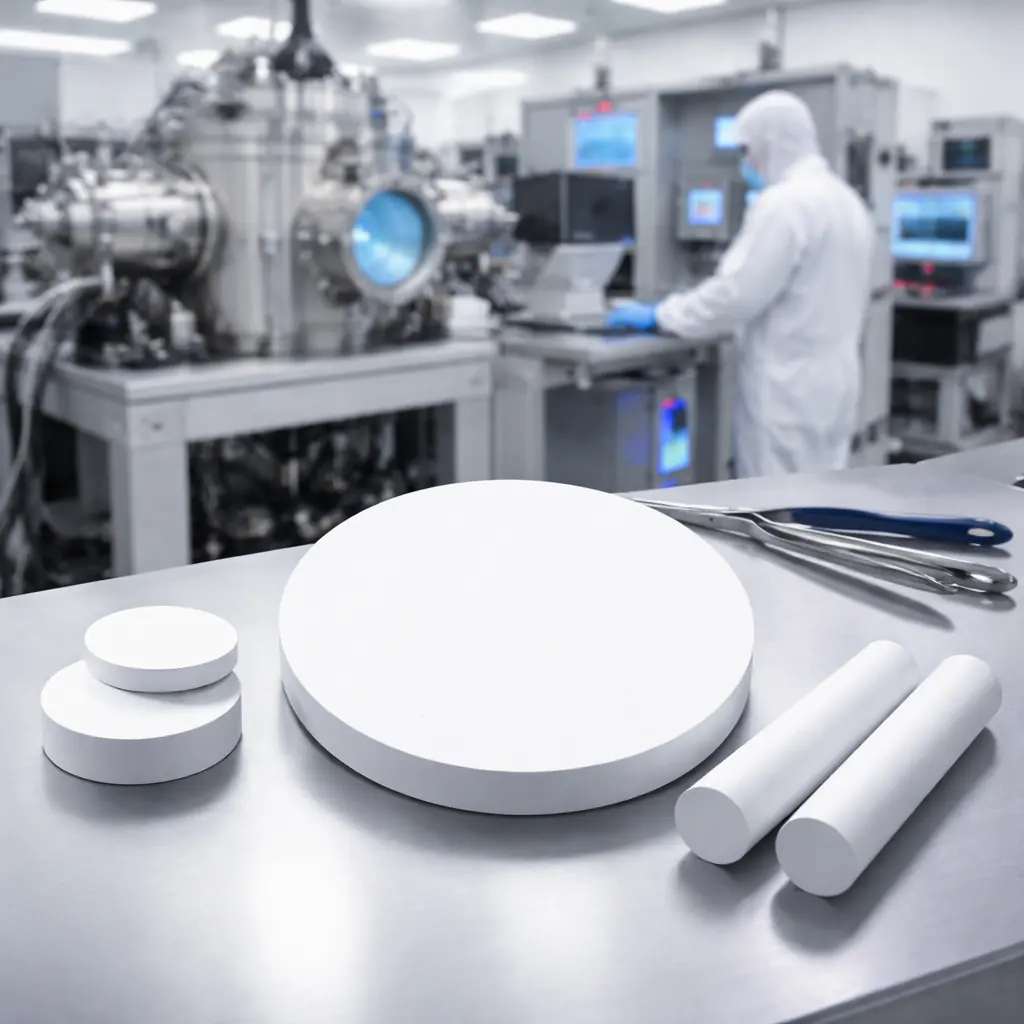
TiO₂ sputtering targets are specialized ceramic materials used in physical vapor deposition (PVD) processes, particularly magnetron sputtering, to produce thin films with precise control over thickness, composition, and microstructure. The quality of TiO₂ sputtering targets directly influences the properties of deposited films, including crystallinity, optical characteristics, and photocatalytic activity [1]. High-density TiO₂ targets with controlled stoichiometry are essential for producing films with optimal performance in energy applications.
The manufacturing of TiO₂ sputtering targets typically involves powder processing, pressing, and high-temperature sintering to achieve densities exceeding 95% of theoretical value. Target composition, particularly the oxygen-to-titanium ratio, significantly affects the sputtering process and film properties. Non-stoichiometric TiO₂₋ₓ targets have been shown to enable higher deposition rates while maintaining film quality [2]. The target microstructure, including grain size and porosity, influences sputtering stability, deposition rate, and film uniformity.
2. TiO₂ Thin Film Deposition by Sputtering
2.1 Sputtering Techniques and Parameters
Magnetron sputtering is the predominant technique for depositing TiO₂ thin films from ceramic targets. Both direct current (DC) and radio frequency (RF) magnetron sputtering are employed, with RF sputtering being particularly suitable for insulating TiO₂ targets. The deposition process involves several critical parameters:
- Target composition: Stoichiometric TiO₂ versus oxygen-deficient TiO₂₋ₓ targets affect deposition rates and film properties [2].
- Sputtering power: Influences deposition rate, film density, and crystallinity.
- Gas composition: Argon-oxygen mixtures control film stoichiometry and phase formation.
- Substrate temperature: Affects crystallinity, with higher temperatures promoting anatase or rutile phase formation.
- Working pressure: Impacts film density and microstructure.
Recent developments in DC magnetron sputtering have enabled the deposition of photocatalytic nanostructured TiO₂ coatings with controlled morphology and enhanced activity [1]. The ability to deposit uniform, adherent TiO₂ films on various substrates makes sputtering an attractive technique for large-scale production of energy conversion devices.
2.2 Film Properties and Characterization
TiO₂ films deposited by sputtering exhibit properties highly dependent on deposition conditions. Key characteristics include:
- Crystal structure: Anatase, rutile, or mixed phases with different band gaps (anatase: ~3.2 eV, rutile: ~3.0 eV).
- Optical properties: High transparency in the visible range with strong UV absorption.
- Electrical properties: n-type semiconductor behavior with controllable conductivity through doping.
- Surface morphology: Nanostructured surfaces with high surface area for catalytic applications.
The influence of target composition on reactively sputtered titanium oxide films has been systematically studied, revealing that target stoichiometry affects not only deposition rates but also film crystallinity and optical properties [3].
3. Photocatalytic Water Splitting Applications
3.1 Fundamentals of TiO₂ Photocatalysis
TiO₂ is one of the most extensively studied photocatalysts for water splitting due to its chemical stability, non-toxicity, and suitable band edge positions for water redox reactions. The photocatalytic process involves three main steps:
- Photon absorption generating electron-hole pairs.
- Charge carrier separation and migration to the surface.
- Surface redox reactions for hydrogen and oxygen evolution [4].
The efficiency of TiO₂ photocatalysts for overall water splitting depends critically on crystal phase, surface structure, and defect engineering. Different TiO₂ phases (anatase, rutile, brookite) exhibit varying photocatalytic activities due to differences in band structure, charge carrier mobility, and surface reactivity [5].
3.2 Sputtered TiO₂ Films for Water Splitting
Sputtering enables precise control over TiO₂ film properties for optimized photocatalytic performance. Key advantages include:
- Controlled crystallinity: Sputtering parameters can be tuned to favor the anatase phase, which generally shows higher photocatalytic activity than rutile for water splitting [1].
- Doping incorporation: Metallic and non-metallic dopants can be incorporated during sputtering to modify band structure and extend light absorption into the visible range.
- Nanostructure engineering: Sputtering conditions can be optimized to create porous, high-surface-area films that enhance light absorption and provide more active sites.
Recent research has demonstrated that β-NiS/TiO₂₋ₓ Ohmic junctions fabricated via sputtering approaches significantly boost photocatalytic overall water splitting performance by facilitating charge separation and transfer [6]. The creation of oxygen vacancies in TiO₂₋ₓ films enhances visible light absorption and improves charge carrier dynamics.
3.3 Performance Enhancement Strategies
Several strategies have been developed to enhance the water splitting efficiency of sputtered TiO₂ films:
- Heterojunction formation: Combining TiO₂ with other semiconductors (e.g., ZnS, g-C₃N₄) to create type-II or Z-scheme heterojunctions that improve charge separation [7].
- Co-catalyst deposition: Loading noble metals (Pt, Au) or transition metal compounds (NiO, Co₃O₄) as co-catalysts to reduce overpotentials for hydrogen evolution.
- Surface modification: Creating nanostructured surfaces with increased active sites and improved light trapping.
- Doping engineering: Introducing cation (Nb⁵⁺, Ta⁵⁺) or anion (N³⁻, S²⁻) dopants to modify band structure and extend visible light response.
Design strategies for photocatalytic hydrogen evolution reaction of TiO₂ emphasize the importance of optimizing charge separation efficiency, surface reaction kinetics, and light absorption characteristics [8].
4. Dye-Sensitized Solar Cell Applications
4.1 TiO₂ in DSSC Architecture
In dye-sensitized solar cells, TiO₂ serves as the photoanode material, providing a high-surface-area scaffold for dye adsorption and facilitating electron transport. The performance of DSSCs depends critically on the properties of the TiO₂ layer, including:
- Surface area: High surface area enables greater dye loading.
- Pore structure: Interconnected porosity allows electrolyte penetration.
- Crystallinity: High crystallinity reduces electron recombination.
- Electron transport: Efficient pathways for electron collection at the transparent conducting oxide (TCO) substrate.
Sputtering offers unique advantages for DSSC photoanode fabrication, including excellent film adhesion, uniform thickness control, and compatibility with various substrate materials.
4.2 Sputtered TiO₂ Photoanodes for DSSCs
Recent advances in sputtered TiO₂ photoanodes for DSSCs include:
- Multilayer structures: Alternating TiO₂ active layers with different morphologies and properties have been shown to enhance DSSC efficiency by optimizing light absorption and electron transport [9]. These structures typically combine dense underlayers for good electrical contact with porous overlayers for high dye loading.
- Nanostructured coatings: TiO₂-coated silver nanowire-incorporated tri-layered photoanodes demonstrate significantly improved performance by combining the high conductivity of silver nanowires with the photocatalytic properties of TiO₂ [10]. This approach enhances electron collection efficiency while maintaining high surface area for dye adsorption.
- Hierarchical architectures: 3D hierarchical rutile TiO₂ nanostructures synthesized via solvothermal methods and deposited by sputtering techniques show enhanced light scattering and electron transport properties [11]. These structures improve light harvesting efficiency, particularly in the red and near-infrared regions.
4.3 Efficiency Enhancement Approaches
Several approaches have been developed to enhance DSSC efficiency using sputtered TiO₂:
- Scattering layer integration: High-yield TiO₂ submicron sphere/nanoparticle-blended scattering layers improve light harvesting by increasing the optical path length within the photoanode [12].
- Surface modification: TiO₂/ZnS core-shell structures created through sequential sputtering reduce electron recombination at the TiO₂/electrolyte interface [13].
- Doping strategies: Incorporating elements like Nb, Ta, or La into TiO₂ improves electron conductivity and reduces recombination losses.
- Multi-dimensional photoelectrodes: Novel multi-dimensional TiO₂ photoelectrodes combining nanoparticles, nanotubes, and nanosheets significantly enhance DSSC efficiency through improved charge collection and light management [14].
5. Comparative Analysis and Performance Metrics
5.1 Photocatalytic Water Splitting Performance
The performance of sputtered TiO₂ films for photocatalytic water splitting is typically evaluated using several metrics:
- Hydrogen evolution rate: Measured in μmol/h or mmol/g·h under standardized illumination conditions.
- Quantum efficiency: The ratio of reacted electrons to incident photons at specific wavelengths.
- Stability: Long-term performance under continuous operation.
- Solar-to-hydrogen (STH) efficiency: Overall energy conversion efficiency under AM1.5G solar illumination.
Recent studies report hydrogen evolution rates exceeding 100 μmol/h·g for optimized sputtered TiO₂-based photocatalysts, with quantum efficiencies approaching 10% at specific wavelengths for doped or composite structures [6,8].
5.2 DSSC Performance Parameters
For DSSC applications, key performance parameters include:
- Power conversion efficiency (PCE): Typically ranging from 5-15% for TiO₂-based devices.
- Short-circuit current density (Jsc): Influenced by light harvesting efficiency and charge collection.
- Open-circuit voltage (Voc): Determined by the quasi-Fermi level of TiO₂ and redox potential of the electrolyte.
- Fill factor (FF): Affected by series and shunt resistances.
State-of-the-art sputtered TiO₂ photoanodes achieve PCE values exceeding 10%, with optimized multilayer and nanostructured designs pushing efficiencies toward 12-13% [10,14]. The combination of high surface area, controlled crystallinity, and efficient electron transport pathways contributes to these performance levels.

6. Challenges and Future Perspectives
6.1 Current Limitations
Despite significant progress, several challenges remain in the application of TiO₂ sputtering targets for energy conversion:
- Limited visible light absorption: The wide band gap of TiO₂ restricts utilization of the solar spectrum to UV region (~4% of solar energy).
- Charge recombination: Rapid recombination of photogenerated electron-hole pairs limits quantum efficiency.
- Scalability and cost: Large-scale production of high-quality TiO₂ sputtering targets and efficient deposition processes require further optimization.
- Long-term stability: Photocorrosion and degradation under operational conditions affect device lifetime.
6.2 Future Research Directions
Future research should focus on several promising directions:
- Band engineering: Developing TiO₂-based materials with reduced band gaps through doping, solid solution formation, or heterostructure design.
- Advanced target design: Creating graded or composite targets that enable deposition of functionally graded or multilayer films in a single process.
- Process optimization: Developing high-throughput sputtering processes with improved energy efficiency and material utilization.
- Integration with other technologies: Combining sputtered TiO₂ with perovskite solar cells, photoelectrochemical cells, or tandem devices for enhanced performance.
- Machine learning approaches: Utilizing computational methods to optimize target composition and sputtering parameters for specific applications.
7. Conclusion
TiO₂ sputtering targets play a crucial role in advancing renewable energy technologies through the deposition of high-quality thin films for photocatalytic water splitting and dye-sensitized solar cells. The ability to precisely control film properties through sputtering parameters and target design enables optimization of performance for specific applications. Recent advances in nanostructured coatings, doping strategies, and heterojunction engineering have significantly improved the efficiency of TiO₂-based energy conversion devices. Continued research in target manufacturing, deposition process optimization, and material design will further enhance the performance and scalability of TiO₂-based technologies. As the demand for sustainable energy solutions grows, TiO₂ sputtering targets will remain essential components in the development of efficient, cost-effective, and durable energy conversion systems.
Titanium Dioxide Sputtering Targets (TiO2 Sputtering Targets) | TiO2-ST
AtoZmat —— Advanced Materials from A to Z.
References
- Villamayor, A.; Pomone, T.; Perero, S.; Ferraris, M.; Barrio, V. L.; G-Berasategui, E.; Kelly, P. Development of Photocatalytic Nanostructured TiO2 and NiO/TiO2 Coatings by DC Magnetron Sputtering for Photocatalytic Applications. Ceramics International 2023, 49 (11), 19309–19317. DOI: 10.1016/j.ceramint.2023.03.058
- Ohsaki, H.; Tachibana, Y.; Hayashi, A.; Mitsui, A.; Hayashi, Y. High Rate Sputter Deposition of TiO 2 from TiO 2−x Target. Thin Solid Films 1999, 351 (1–2), 57–60. DOI: 10.1016/s0040-6090(99)00207-2
- Kubart, T.; Jensen, J.; Nyberg, T.; Liljeholm, L.; Depla, D.; Berg, S. Influence of the Target Composition on Reactively Sputtered Titanium Oxide Films. Vacuum 2009, 83 (10), 1295–1298. DOI: 10.1016/j.vacuum.2009.03.026
- Li, R.; Weng, Y.; Zhou, X.; Wang, X.; Mi, Y.; Chong, R.; Han, H.; Li, C. Achieving Overall Water Splitting Using Titanium Dioxide-Based Photocatalysts of Different Phases. Energy & Environmental Science 2015, 8 (8), 2377–2382. DOI: 10.1039/c5ee01398d
- Ding, H.; Zha, D.; Han, S.; Jiang, N. Design Strategy for Photocatalytic Hydrogen Evolution Reaction of TiO2: A Review. Journal of the Taiwan Institute of Chemical Engineers 2023, 151, 105135. DOI: 10.1016/j.jtice.2023.105135
- Liu, J.; Wan, Y.; Xie, Y.; Dong, F.; Yang, K.; Li, X. Boosting Photocatalytic Overall Water Splitting by β-NiS/TiO2-x Ohmic Junction. Applied Catalysis B: Environment and Energy 2025, 379, 125690. DOI: 10.1016/j.apcatb.2025.125690
- Srinivasa Rao, S.; Punnoose, D.; Venkata Tulasivarma, Ch.; Pavan Kumar, C. H. S. S.; Gopi, Chandu. V. V. M.; Kim, S.-K.; Kim, H.-J. A Strategy to Enhance the Efficiency of Dye-Sensitized Solar Cells by the Highly Efficient TiO2/ZnS Photoanode. Dalton Transactions 2015, 44 (5), 2447–2455. DOI: 10.1039/c4dt03102d
- Ding, H.; Zha, D.; Han, S.; Jiang, N. Design Strategy for Photocatalytic Hydrogen Evolution Reaction of TiO2: A Review. Journal of the Taiwan Institute of Chemical Engineers 2023, 151, 105135. DOI: 10.1016/j.jtice.2023.105135
- Liu, X.; Zhang, C.; Liu, S.; Xiong, Y. Efficiency Enhancement of DSSC by Alternating TiO2 Active Layer. Optik 2018, 160, 277–282. DOI: 10.1016/j.ijleo.2018.02.008
- Kankanamge, H. K. H. D.; Kumari, J. M. K. W.; Dissanayake, M. A. K. L.; Senadeera, G. K. R.; Dassanayake, B. S.; Perera, H. C. S. Highly Efficient Dye-Sensitized Solar Cells with TiO2-Coated Silver Nanowire-Incorporated Tri-Layered Photoanode. Bulletin of Materials Science 2023, 46 (3). DOI: 10.1007/s12034-023-02977-5
- Arthi, G.; Archana, J.; Navaneethan, M.; Ponnusamy, S.; Hayakawa, Y.; Muthamizhchelvan, C.; Ramaraj, S. G. Solvothermal Synthesis of 3D Hierarchical Rutile TiO2 Nanostructures for Efficient Dye-Sensitized Solar Cells. Materials Letters 2023, 337, 133961. DOI: 10.1016/j.matlet.2023.133961
- Shahid, M. U.; Mohamed, N. M.; Muhsan, A. S.; Zaine, S. N. A.; Yar, A.; Ahmad, W.; Irshad, M. I.; Hussain, M. B. High-Yield TiO2 Submicron Sphere/Nanoparticle-Blended Scattering Layer for Efficient and Scalable Dye-Sensitized Solar Cells. Emergent Materials 2023, 6 (2), 671–679. DOI: 10.1007/s42247-023-00467-2
- Srinivasa Rao, S.; Punnoose, D.; Venkata Tulasivarma, Ch.; Pavan Kumar, C. H. S. S.; Gopi, Chandu. V. V. M.; Kim, S.-K.; Kim, H.-J. A Strategy to Enhance the Efficiency of Dye-Sensitized Solar Cells by the Highly Efficient TiO2/ZnS Photoanode. Dalton Transactions 2015, 44 (5), 2447–2455. DOI: 10.1039/c4dt03102d
- Zhao, F.; Ma, R.; Jiang, Y. Strong Efficiency Improvement in Dye-Sensitized Solar Cells by Novel Multi-Dimensional TiO2 Photoelectrode. Applied Surface Science 2018, 434, 11–15. DOI: 10.1016/j.apsusc.2017.10.131