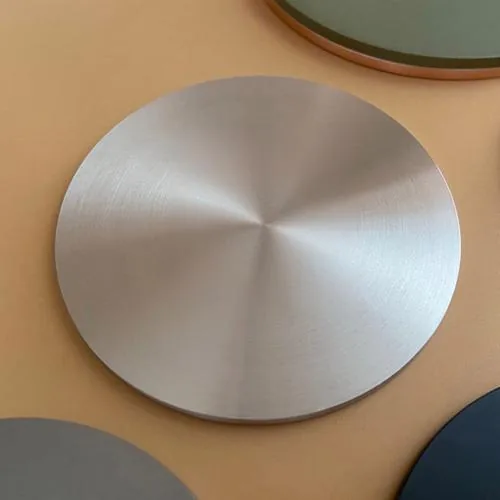
Aluminum-scandium (AlSc) alloys represent a unique class of materials that bridge two critical technological domains: aerospace high-temperature applications and advanced semiconductor interconnect technology. This article explores the dual functionality of AlSc sputtering targets, examining their role in producing high-performance aerospace alloys through powder metallurgy and their application in depositing thin films for integrated circuit interconnects. The synergistic effects of scandium addition to aluminum matrices provide enhanced mechanical properties at elevated temperatures while simultaneously improving the reliability and performance of semiconductor metallization layers.
1. What is an AlSc Sputtering Target: Aerospace High-Temperature Alloy and IC Interconnect Films
Aluminum-scandium alloys have emerged as versatile materials with applications spanning from aerospace engineering to microelectronics manufacturing. The addition of scandium to aluminum creates Al₃Sc precipitates that significantly enhance mechanical properties through precipitation strengthening mechanisms [1]. These alloys can be processed into sputtering targets that serve dual purposes:
- Manufacturing bulk aerospace components
- Depositing thin films for semiconductor interconnects
2. Material Properties and Microstructure
2.1 Precipitation Strengthening Mechanisms
The primary strengthening mechanism in AlSc alloys arises from the formation of coherent L1₂-Al₃Sc precipitates. These nanoscale precipitates effectively pin dislocations and grain boundaries, resulting in significant improvements in:
- Strength
- Thermal stability
- Creep resistance [2]
The Al₃Sc precipitates maintain coherency with the aluminum matrix up to approximately 350°C, providing exceptional high-temperature stability.
2.2 Microstructural Evolution
Studies on Al-Mg-Sc-Zr alloys have demonstrated that annealing treatments significantly influence microstructure and mechanical properties. Proper heat treatment can optimize the distribution and size of Al₃(Sc,Zr) precipitates, leading to enhanced strength-ductility combinations [3]. The heterogeneous distribution of scandium plays a crucial role in precipitation behavior, affecting both nucleation kinetics and precipitate morphology.
3. Aerospace High-Temperature Applications
3.1 High-Temperature Mechanical Performance
AlSc alloys exhibit remarkable high-temperature deformation characteristics. Research on supersaturated Al-Sc-Zr alloys produced via melt-spinning and extrusion has shown excellent thermal stability and mechanical properties at elevated temperatures [4]. These materials maintain their strength well above 300°C, making them suitable for aerospace components exposed to high thermal loads.
3.2 Manufacturing Processes
Spark plasma sintering (SPS) has emerged as an effective method for producing AlSc alloys from prealloyed powders. This technique allows for precise control of microstructure and density, resulting in materials with optimized mechanical properties [5]. The SPS process enables the retention of fine-grained structures and homogeneous distribution of strengthening precipitates.
3.3 Recent Advances in Heat-Resistant Alloys
New insights into the effects of Sc/Zr additions on heat-resistant Al-8Ce alloys have revealed significant improvements in high-temperature performance [6]. The synergistic effects of multiple rare earth elements create complex precipitation sequences that enhance thermal stability and creep resistance.
4. Semiconductor Interconnect Applications
4.1 Sputter Deposition Technology
AlSc sputtering targets enable the deposition of high-quality thin films for integrated circuit interconnects. Advanced sputter deposition technologies have been developed for Al₁₋ₓScₓN films with high scandium concentrations [7]. These technologies allow precise control of film composition and microstructure, critical for semiconductor applications.
4.2 Via Filling and Reliability
A highly reliable via filling technology using high-temperature Al-Sc alloy sputter deposition has been demonstrated for semiconductor manufacturing [8]. This approach improves step coverage and reduces void formation in high-aspect-ratio vias, enhancing interconnect reliability. The AlSc films exhibit superior electromigration resistance compared to pure aluminum interconnects.
4.3 Stress Management in Interconnects
Stress in Al-Sc interconnection layers has been extensively studied, revealing that scandium addition can modify residual stress states in thin films [9]. Proper control of sputtering parameters and scandium content allows optimization of film stress, reducing the risk of:
- Stress-induced voiding
- Hillock formation
5. Sputtering Target Fabrication and Performance
5.1 Target Manufacturing
The fabrication of AlSc sputtering targets requires careful control of composition homogeneity and microstructure. Large-size alloy targets with high scandium content have been developed for industrial-scale deposition processes [10]. These targets must exhibit uniform erosion characteristics and consistent film properties throughout their operational lifetime.
5.2 Film Deposition Characteristics
Reactive sputtering of AlScN thin films with variable scandium content on 200 mm wafers has been demonstrated, showing excellent compositional control and film uniformity [11]. The sputtering process parameters significantly influence film properties, including:
- Crystallographic orientation
- Stress state
- Electrical characteristics
5.3 Ferroelectric Applications
Recent advances have enabled room-temperature deposition of poling-free ferroelectric AlScN films by reactive sputtering [12]. These films exhibit promising piezoelectric and ferroelectric properties for microelectromechanical systems (MEMS) and memory applications, expanding the utility of AlSc sputtering targets beyond conventional metallization.
6. Comparative Analysis: Aerospace vs. Semiconductor Applications
6.1 Material Requirements
While both applications utilize AlSc alloys, their requirements differ significantly:
- Aerospace applications prioritize bulk mechanical properties, fatigue resistance, and thermal stability.
- Semiconductor applications focus on thin film properties, electrical conductivity, and interface characteristics.
6.2 Processing Considerations
- Aerospace components typically involve bulk processing techniques such as casting, forging, or powder metallurgy.
- Semiconductor applications require precise thin film deposition with atomic-level control.
The sputtering targets must be optimized for each application’s specific requirements.
6.3 Performance Metrics
- For aerospace alloys: Key metrics include yield strength, fracture toughness, and creep resistance at elevated temperatures.
- For interconnect films: Critical parameters are resistivity, electromigration lifetime, stress migration resistance, and adhesion to dielectric layers.
7. Future Perspectives and Challenges
7.1 Material Development
Future research directions include the development of novel AlSc alloy compositions with enhanced properties for both aerospace and semiconductor applications. The incorporation of additional alloying elements—such as zirconium, magnesium, or rare earth elements—may further improve performance.
7.2 Manufacturing Scale-up
Challenges remain in scaling up the production of high-quality AlSc sputtering targets while maintaining cost-effectiveness. The high cost of scandium continues to be a limiting factor for widespread adoption, driving research into more efficient utilization and recycling strategies.
7.3 Integration Challenges
For semiconductor applications, integration challenges include:
- Compatibility with existing fabrication processes
- Thermal budget constraints
- Interface engineering with adjacent materials
Advanced deposition techniques and barrier layer development will be crucial for successful implementation.
8. Conclusion
AlSc sputtering targets represent a convergence of materials science and engineering that serves two technologically demanding fields. The unique properties imparted by scandium addition to aluminum create materials that excel in both high-temperature aerospace applications and advanced semiconductor interconnects. Continued research and development in this area promises to yield further improvements in performance, reliability, and cost-effectiveness, enabling new generations of aerospace components and electronic devices.
The dual functionality of AlSc alloys highlights the importance of fundamental materials research in driving technological innovation across multiple industries. As manufacturing techniques advance and our understanding of microstructure-property relationships deepens, AlSc materials are poised to play an increasingly significant role in both aerospace and microelectronics applications. AtoZmat —— Advanced Materials from A to Z.
References
- Sumisaka, M.; Yamazaki, K.; Fujii, S.; Tang, G.; Han, T.; Suzuki, Y.; Otomo, S.; Omori, T.; Hashimoto, K. Sputter Deposition of ScAlN Using Large Size Alloy Target with High Sc Content and Reduction of Sc Content in Deposited Films. Japanese Journal of Applied Physics 2015, 54 (7S1), 07HD06. DOI: 10.7567/jjap.54.07hd06
- Cooke, R. W.; Kraus, N. P.; Bishop, D. P. Spark Plasma Sintering of Aluminum Powders Prealloyed with Scandium Additions. Materials Science and Engineering: A 2016, 657, 71–81. DOI: 10.1016/j.msea.2016.01.053
- Shen, J.; Chen, B.; Wan, J.; Shen, J.; Li, J. Effect of Annealing on Microstructure and Mechanical Properties of an Al–Mg-Sc-Zr Alloy. Materials Science and Engineering: A 2022, 838, 142821. DOI: 10.1016/j.msea.2022.142821
- Yang, Y.; Hackney, S. A.; Sanders, P. G. High-Temperature Deformation of Supersaturated Al-Sc-Zr Produced via Melt-Spinning and Extrusion. Materials Science and Engineering: A 2022, 857, 144138. DOI: 10.1016/j.msea.2022.144138
- Cooke, R. W.; Kraus, N. P.; Bishop, D. P. Spark Plasma Sintering of Aluminum Powders Prealloyed with Scandium Additions. Materials Science and Engineering: A 2016, 657, 71–81. DOI: 10.1016/j.msea.2016.01.053
- New insights into the effects of Sc/Zr addition on heat-resistant Al-8Ce alloy. Journal of Alloys and Compounds 2025, 178728. DOI: 10.1016/j.jallcom.2025.178728
- Heinz, B.; Mertin, S.; Rattunde, O.; Dubois, M. A.; Nicolay, S.; Christmann, G.; Tschirky, M.; Muralt, P. Sputter Deposition Technology for Al₁₋ₓScₓN Films with High Sc Concentration. In 2017 China Semiconductor Technology International Conference (CSTIC); IEEE, 2017; pp 1–3. DOI: 10.1109/cstic.2017.7919885
- Nishimura, H.; Ogawa, S.; Yamada, T. A Highly Reliable via Filling Technology Using High-Temperature Al-Sc Alloy Sputter Deposition. In Proceedings of IEEE International Electron Devices Meeting; IEEE; pp 281–284. DOI: 10.1109/iedm.1993.347351
- Hara, T.; Hosoda, N.; Nagano, S.; Ueda, T. Stress in Al-Sc Interconnection Layers. Japanese Journal of Applied Physics 1993, 32 (10A), L1394. DOI: 10.1143/jjap.32.l1394
- Sumisaka, M.; Yamazaki, K.; Fujii, S.; Tang, G.; Han, T.; Suzuki, Y.; Otomo, S.; Omori, T.; Hashimoto, K. Sputter Deposition of ScAlN Using Large Size Alloy Target with High Sc Content and Reduction of Sc Content in Deposited Films. Japanese Journal of Applied Physics 2015, 54 (7S1), 07HD06. DOI: 10.7567/jjap.54.07hd06
- Reactive sputtering of AlScN thin films with variable Sc content on 200 mm wafers. In 2018 European Frequency and Time Forum (EFTF); IEEE, 2018. DOI: 10.1109/eftf.2018.8408987
- Publisher’s Note: “Room-temperature deposition of a poling-free ferroelectric AlScN film by reactive sputtering” [Appl. Phys. Lett. 118, 082902 (2021)]. Applied Physics Letters 2021, 118 (8), 082902. DOI: 10.1063/5.0049325