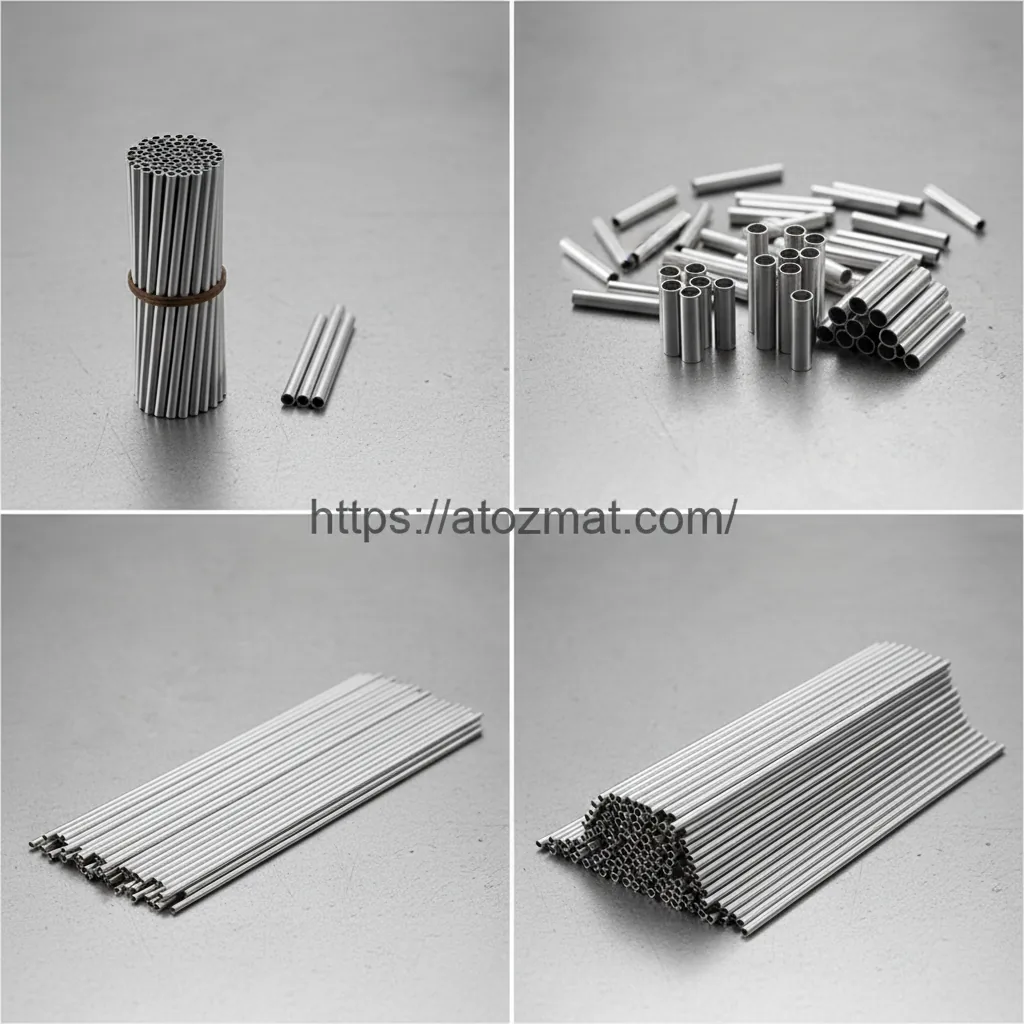
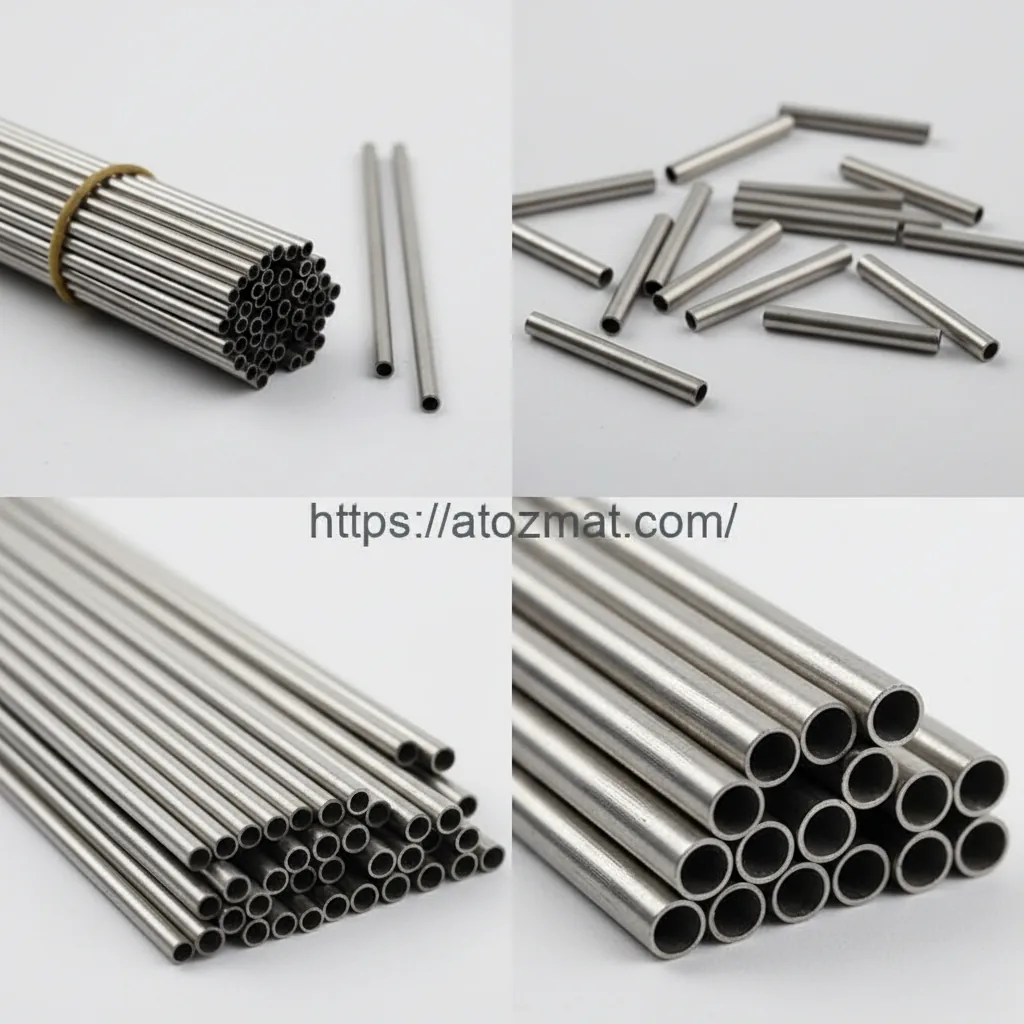
Niobium-1% zirconium (Nb-1Zr) is a well-established refractory alloy used where conventional stainless steels, nickel alloys, and many ceramics become limiting because of temperature capability, creep resistance, or contamination concerns. In capillary form, the alloy is especially relevant for applications requiring narrow internal passages, dimensional precision, low vapor pressure, and stable performance in vacuum or controlled atmospheres. Typical use cases include high-temperature instrumentation, furnace hardware, laboratory flow paths, feedthrough-related components, and specialized materials-processing systems.
For technical users evaluating capillary materials, Nb1Zr sits in an important niche. Pure niobium offers high melting point and good fabricability, but alloying with a small zirconium addition improves elevated-temperature strength and creep behavior while preserving much of niobium’s ductility and workability. That combination makes Nb1Zr capillaries attractive where thin-walled geometry must survive thermal stress, handling, and prolonged service without excessive embrittlement or distortion.
Capillaries made from refractory alloys are often selected not because they are universally corrosion resistant, but because they retain mechanical and dimensional integrity under conditions that are inaccessible to common structural metals. Nb1Zr is one such material. Its value is highest in vacuum, inert gas, and carefully controlled reducing environments, especially when thermal loads are high and contamination from volatile species must be minimized.
Compared with larger tubes, capillaries impose tighter demands on metallurgy and manufacturing quality. Small defects that are tolerable in bulk stock can become critical in fine tubing: internal surface inclusions can disturb flow or act as crack initiators; residual cold work can increase springback or alter service behavior; oxygen pickup can sharply reduce ductility; and wall-thickness variation can affect thermal gradients and burst performance. As a result, understanding the alloy’s metallurgical behavior is as important as knowing its nominal composition.
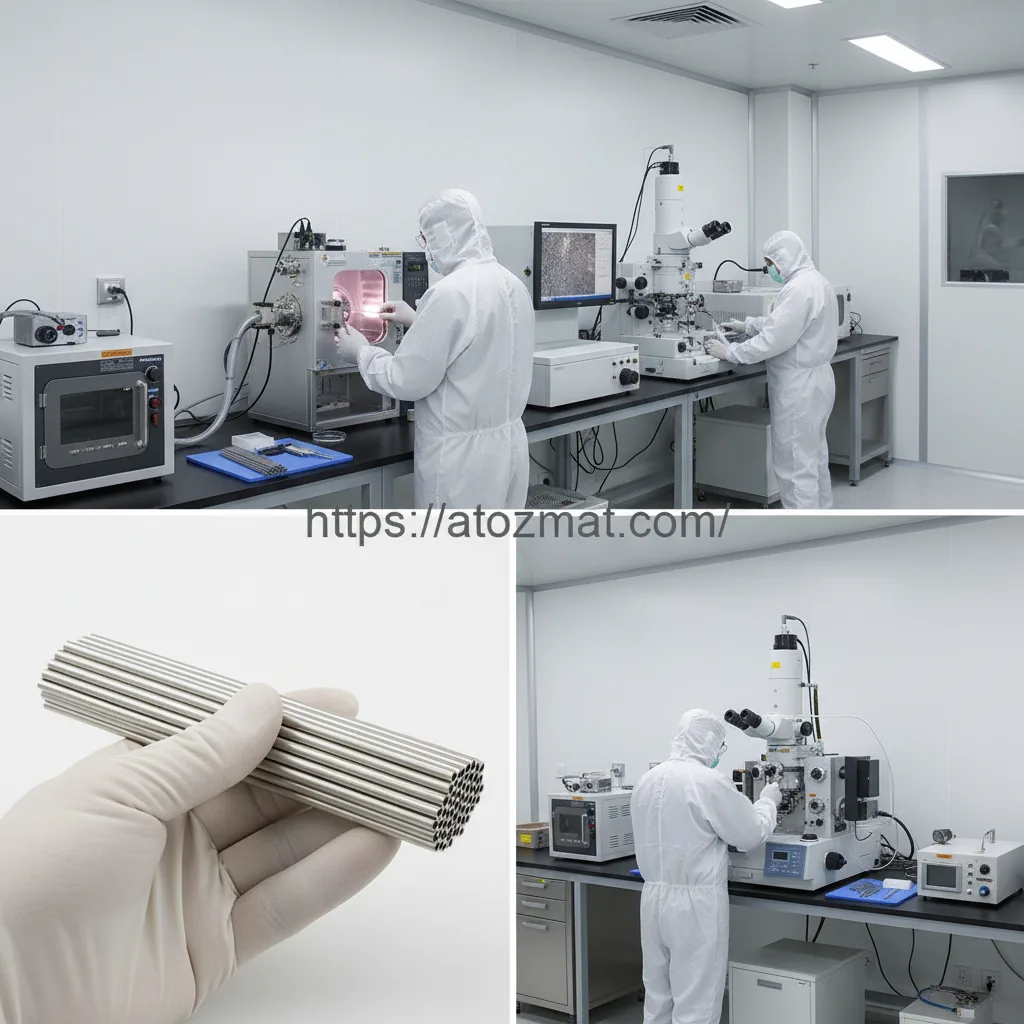
Research laboratory application context for Niobium Zirconium Alloy Capillary (Nb1Zr Alloy Capillary) | N021
Technical Background
Nb1Zr is a niobium-based alloy containing approximately 1 wt% zirconium. Zirconium functions as a solid-solution strengthener and also interacts strongly with interstitial species such as oxygen. In properly processed material, this small addition improves high-temperature strength relative to commercially pure niobium, especially under sustained load. The alloy remains relatively low in density for a refractory metal and maintains a high melting point characteristic of niobium-based systems.
Several material features are particularly relevant for capillary products:
High-temperature capability: Useful at temperatures beyond the practical range of many stainless and nickel-based alloys, provided the environment is compatible.
Low vapor pressure: Important in vacuum systems, thermal processing, and analytical environments where evaporative contamination must be limited.
Good formability relative to many refractory metals: Supports tube drawing and fabrication into small-diameter capillary geometries.
Improved creep resistance over pure niobium: Beneficial for long-duration thermal exposure.
Sensitivity to interstitial contamination: Oxygen, nitrogen, hydrogen, and carbon can significantly alter ductility and service life.
The alloy’s service behavior is dominated less by bulk chemistry than by the interaction among purity, grain structure, residual deformation, and environment. For narrow-bore tubing, the internal surface condition is often a primary determinant of performance. Roughness, oxide scale, embedded lubricants from drawing, or particulate residue can become unacceptable in analytical, semiconductor-adjacent, or high-purity thermal applications.
Processing and Manufacturing Considerations
Producing Nb1Zr capillaries generally involves multiple stages of melting, hot working, tube reduction, drawing, intermediate annealing, and final cleaning. Each stage affects final integrity.
Melting and Purity Control
Because niobium is highly reactive at elevated temperatures, upstream melting and consolidation must minimize pickup of oxygen and nitrogen. Vacuum arc remelting or related high-purity refractory-metal processing routes are commonly used to achieve uniform composition and low contamination. For capillary stock, purity matters not only for bulk mechanical properties but also for downstream drawability and fracture resistance. Even small increases in interstitial content can raise hardness while reducing formability.
Tube Drawing and Intermediate Annealing
Capillary production typically relies on staged reduction to achieve the required outer diameter, inner diameter, and wall thickness. As reduction proceeds, work hardening accumulates. Intermediate anneals are therefore critical for restoring ductility and limiting crack formation, especially in thin-wall sections. Annealing parameters influence recrystallized grain size, which in turn affects both room-temperature handling and elevated-temperature creep behavior.
A very fine grain size may improve certain fabrication steps and dimensional consistency, but coarse grains can become problematic in capillaries because they may increase anisotropy, distort local deformation, and reduce reliability in tight bends or flare operations. Conversely, heavily cold-worked material can retain high strength but may show less forgiving behavior during assembly. The optimal condition depends on whether the capillary will be further formed, welded, heated in service, or used as-received.
Surface Condition and Cleanliness
For small-diameter tubes, cleaning quality is not secondary. Drawing lubricants, residual oxides, and embedded tooling debris can affect vacuum performance, outgassing, wetting behavior, and flow purity. Chemical cleaning and controlled finishing are therefore important, especially if the capillary will be exposed to high vacuum or high-temperature gas handling. In research environments, users often evaluate both outer and inner surface condition because internal contamination is harder to remove after assembly.
Service Behavior in Reactive and High-Temperature Environments
Nb1Zr performs best in vacuum, inert atmospheres such as argon or helium, and selected reducing conditions. The alloy is not a universal oxidation-resistant material. In air, niobium-based alloys oxidize readily at elevated temperature, and the resulting oxygen ingress can embrittle the metal beneath the oxide scale. For that reason, service in oxidizing atmospheres generally requires environmental control, protective encapsulation, or very limited exposure time.
Hydrogen behavior also deserves attention. Niobium can absorb hydrogen, and under some conditions hydride-related embrittlement or altered mechanical response may result, particularly during cooldown or cyclic exposure. Gas purity, dew point control, and post-service degassing strategies may matter for capillaries used in hydrogen-containing systems. Similarly, nitrogen and carbon pickup at high temperature can degrade ductility and complicate joining.
From a mechanical standpoint, Nb1Zr offers a useful balance of strength and ductility at elevated temperature. The zirconium addition improves resistance to creep deformation compared with pure niobium, making the alloy more suitable for unsupported spans, thermal cycling, and prolonged hot-zone residence. In capillary geometry, this matters because thin walls are inherently vulnerable to ovalization, sagging, and creep-assisted dimensional drift. Where alignment or flow uniformity is important, that extra creep margin can justify the alloy choice.
Joining, Assembly, and Deposition-Related Considerations
Capillary integration often depends on end-forming, brazing, welding, or sealing to refractory or dissimilar materials. Nb1Zr can be welded, but joining must be conducted under high-purity shielding or vacuum because contamination in the weld zone rapidly degrades ductility. Electron beam welding, laser welding, and carefully controlled GTAW-type processes are used in refractory-metal fabrication, though joint design for capillaries must accommodate thin-wall sensitivity and distortion control.
When the capillary is part of a deposition or thermal evaporation system, material compatibility becomes especially important. Niobium-based components are valued for low vapor pressure and high-temperature survivability, but they can react with certain melts, fluxes, or transported species. Users should consider not only nominal corrosion resistance but also interfacial reactions, diffusion, and wetting at operating temperature. In some deposition setups, the capillary may act as a conduit for precursor delivery or as a structural element near the hot zone; in both cases, contamination transfer from the alloy surface can influence film chemistry if process cleanliness is poor.
For thin-film and high-vacuum applications, outgassing is another key variable. Proper degreasing, vacuum firing, or preconditioning may be needed to stabilize the surface before installation. This is particularly relevant for analytical systems and advanced coating tools where background gas levels directly affect film quality, stoichiometry, and defect density.
Applications and Performance Context
Nb1Zr alloy capillaries are relevant in several technical contexts:
High-temperature vacuum furnaces: Sensor protection, gas introduction, or small flow channels near the hot zone.
Materials synthesis systems: Transport of reactive or high-purity gases where thermal stability is required.
Research instrumentation: Custom capillary components for thermal analysis, beamline-adjacent hardware, and vacuum-compatible experimental assemblies.
Aerospace and nuclear-adjacent engineering: Legacy and specialty uses where niobium alloys are selected for refractory performance, provided the environment is well controlled.
Advanced joining and processing fixtures: Precision tubing in laboratory-scale brazing, diffusion, or crystal-growth equipment.
In these applications, the main performance advantage over common alternatives is not broad corrosion resistance, but high-temperature capability combined with relatively favorable fabrication behavior for a refractory alloy. Compared with tungsten or molybdenum systems, Nb1Zr may offer easier forming and joining in certain geometries. Compared with tantalum alloys, it may present a different balance of cost, density, and environment-specific compatibility. Material selection therefore depends strongly on service atmosphere, thermal profile, contamination sensitivity, and mechanical loading.
Challenges and Trade-Offs
The biggest trade-off with Nb1Zr is environmental sensitivity. The alloy performs well when oxygen and other interstitial contaminants are controlled, but can degrade rapidly when they are not. This creates a practical divide: in well-managed vacuum or inert systems, the alloy can be highly effective; in poorly controlled atmospheres or direct oxidizing exposure, it may fail prematurely.
Other engineering trade-offs include:
Cost and processing complexity: Refractory-metal tubing is more specialized than stainless capillary tubing.
Handling sensitivity: Thin-wall refractory alloy parts can be damaged by improper forming or contaminated during assembly.
Inspection difficulty: Internal defects, bore variation, and localized contamination are harder to detect in small-diameter capillaries.
Joining discipline: Welding and brazing demand stricter environmental control than many common alloys.
For technical buyers, this means specification quality matters. Dimensions alone are insufficient. Material condition, cleanliness, expected service atmosphere, and post-fabrication heat treatment may all influence performance more than nominal alloy designation.
Research Directions and Emerging Opportunities
Current work around niobium-based alloys is increasingly shaped by extreme-environment engineering and advanced manufacturing. Several research directions are relevant to Nb1Zr capillaries and related tubing:
Surface engineering and barrier coatings: Efforts to improve oxidation resistance through silicide, aluminide, or multilayer protective systems for short-term or cyclic high-temperature exposure.
Additive and hybrid manufacturing integration: Combining conventionally produced refractory tubing with additively manufactured manifolds, heat shields, or support structures.
Ultra-clean processing for high-vacuum hardware: Better control of outgassing, surface contamination, and residual interstitials for advanced analytical and thin-film systems.
Microstructural optimization: Tailoring recrystallization and grain morphology to balance creep resistance, bendability, and joining reliability in thin sections.
Compatibility studies with reactive media: More detailed evaluation of niobium-alloy interaction with hydrogen-bearing gases, liquid metals, and specialized precursor chemistries.
As thermal systems become more compact and precise, capillary-scale refractory components may see broader use in specialized laboratory and pilot-scale equipment. Their value is likely to increase in environments where conventional alloys become contamination sources or lose dimensional stability.
Conclusion
Nb1Zr alloy capillaries occupy a specialized but important position in high-temperature and high-purity engineering. The alloy combines the refractory characteristics of niobium with improved elevated-temperature strength from zirconium addition, making it suitable for narrow-flow and containment applications in vacuum, inert, and controlled reducing environments. Its performance, however, is tightly linked to purity, microstructure, surface condition, and contamination control throughout manufacturing and service.
For engineers and researchers, successful use of Nb1Zr capillaries depends on matching the material to the real operating environment rather than relying on melting point or alloy designation alone. In the right system, it offers a robust solution for thermally demanding capillary applications. In the wrong environment, especially oxidizing conditions, its limitations become decisive. That materials-selection discipline is what makes refractory alloy capillaries engineering components rather than commodity tubing.