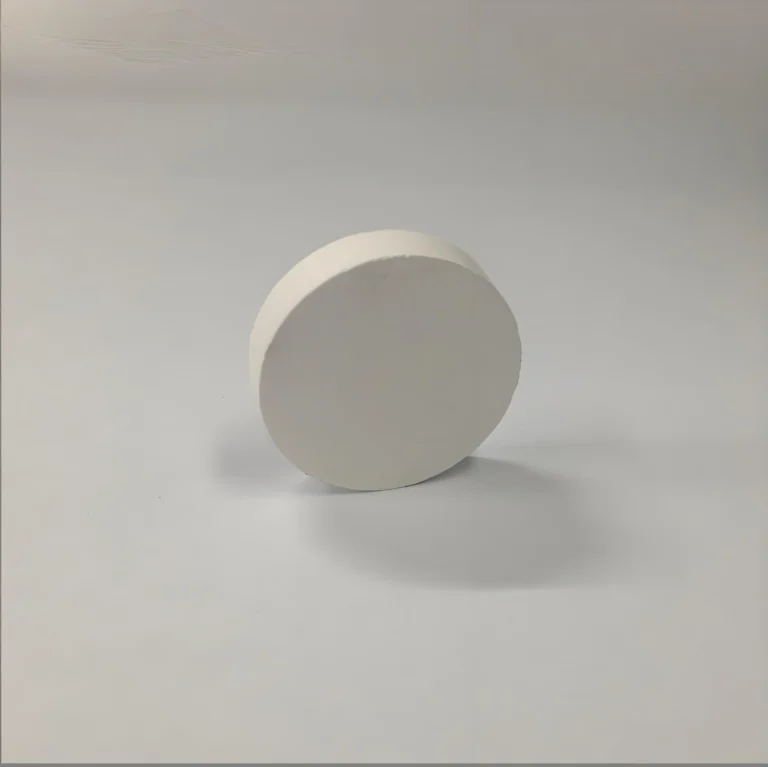
Oxide electronics rely on high-quality interfaces between functional oxide thin films, often requiring buffer layers that provide both structural compatibility and electrical functionality. Strontium aluminate (Sr₃Al₂O₆) has emerged as a uniquely versatile material that can serve as a transparent conductive oxide (TCO) buffer layer. With its cubic crystal structure, wide optical bandgap, water solubility for sacrificial applications, and compatibility with perovskite oxide epitaxy, Sr₃Al₂O₆ sputtering targets present a compelling solution for advanced oxide electronic devices. This article reviews the structural, optical, and electrical properties of Sr₃Al₂O₆, discusses the fabrication of high-density ceramic sputtering targets, and explores its applications as a TCO buffer layer in oxide electronics, including for the synthesis of freestanding oxide membranes.
1. What is Sr₃Al₂O₆ Sputtering Target?
The field of oxide electronics has advanced rapidly, driven by the discovery of emergent phenomena at heterointerfaces between complex oxide thin films. Transparent conductive oxides (TCOs) are essential components in modern optoelectronic devices, including flat-panel displays, solar cells, light-emitting diodes, and transparent thin-film transistors [1].
Conventional TCOs such as indium tin oxide (ITO) and aluminum-doped zinc oxide (AZO) have been the industry standard for decades. However, the search for alternative TCO materials with improved chemical stability, lattice matching to functional oxide films, and novel functionalities continues to be an active area of research.
In this context, Sr₃Al₂O₆—a strontium aluminate compound from the SrO–Al₂O₃ system—has garnered significant attention. Initially studied for its luminescent properties when doped with rare-earth ions, Sr₃Al₂O₆ has found new relevance in oxide electronics as a water-soluble sacrificial buffer layer for the synthesis of freestanding oxide membranes [2], [3]. More recently, its potential as a transparent conductive oxide buffer has been recognized, particularly when fabricated into high-density sputtering targets for physical vapor deposition.
2. Crystal Structure and Fundamental Properties
Sr₃Al₂O₆ crystallizes in the cubic space group Pa3̅ (No. 205) with a lattice parameter of approximately a = 15.86 Å [4].
- Structural Features: The structure is isotypic with Ca₃Al₂O₆ (tricalcium aluminate, a major phase in Portland cement) and features isolated, highly puckered six-membered AlO₆ rings linked by strontium cations coordinated by 6 to 9 oxygen ligands [4].
- Defect Perovskite Nature: Alternatively, the structure can be described as a defect ABO₃ perovskite with 12.5% vacancies in the A-sublattice and 25% oxygen vacancies, with the formula (Sr₇□₁)(Al₃Sr₁)(O₉□₃) [4]. This defect perovskite nature is particularly significant, as it establishes structural compatibility with the broader family of perovskite oxides widely used in oxide electronics.
- Optical Bandgap: The material’s wide bandgap—characteristic of aluminate-based insulators—makes it highly transparent across the visible spectrum and into the ultraviolet range. Alahraché et al. [5] demonstrated that Sr₃Al₂O₆ polycrystalline ceramics exhibit excellent transparency from the visible through the mid-infrared region (up to 6 μm), with complete absence of porosity and very thin grain boundaries that minimize light scattering.
The refractive index and dielectric properties of Sr₃Al₂O₆ are also favorable for optical applications, contributing to its qualification as a TCO buffer material when appropriately doped to induce electrical conductivity.
3. Synthesis of Sr₃Al₂O₆ Powders and Sputtering Targets
3.1 Powder Synthesis Routes
The synthesis of high-purity Sr₃Al₂O₆ powders is the first critical step toward fabricating high-quality sputtering targets. Several chemical synthesis routes have been developed:
- Solid-State Reaction: Traditional solid-state synthesis involves reacting SrCO₃ and Al₂O₃ at high temperatures (~1200 °C). However, this method can yield compositional inhomogeneity [6].
- Citric Acid Precursor Method: Xu et al. [6] demonstrated the synthesis of nanocrystalline Sr₃Al₂O₆ powders via a citric acid precursor route. By controlling the molar ratio of citric acid to total metal cations (CA/M), single-phase Sr₃Al₂O₆ was obtained at temperatures as low as 900 °C (for CA/M = 4), producing nanoparticles with diameters of approximately 50–70 nm [6].
- Tartarate Precursor Method: Mindru et al. [7] reported the synthesis of undoped and doped Sr₃Al₂O₆ through the tartarate precursor route. Single-phase cubic Sr₃Al₂O₆ with an average crystallite size of 18 nm was obtained, with the incorporation of rare-earth dopants such as Tb³⁺ and Eu³⁺ confirmed by energy-dispersive X-ray spectroscopy [7].
3.2 Sputtering Target Fabrication
The fabrication of Sr₃Al₂O₆ sputtering targets requires achieving high density, uniform microstructure, and sufficient mechanical integrity.
Alahraché et al. [5] reported a breakthrough approach: transparent Sr₃Al₂O₆ polycrystalline ceramics elaborated from glass crystallization. The glass synthesis followed by controlled congruent crystallization produced fully dense ceramics (complete absence of porosity) with micrometer-scale crystallites and extremely thin grain boundaries [5]. This method is particularly advantageous compared to conventional high-pressure sintering, as it minimizes light scattering and produces ceramics with hardness H = 6.21 ± 0.16 GPa.
For sputtering target applications, dense ceramic targets with high thermal conductivity and uniform erosion characteristics are essential. The glass-crystallization route offers a viable path to producing large-area, high-density Sr₃Al₂O₆ targets suitable for radio-frequency (RF) magnetron sputtering.
4. Optical and Electronic Properties
4.1 Optical Transparency
Sr₃Al₂O₆ exhibits excellent optical transparency across the visible and near-infrared spectral ranges. The wide bandgap (estimated at >5 eV based on its transparency deep into the ultraviolet) ensures minimal absorption of visible light.
- Rezende et al. [8] studied the optical properties of rare-earth-doped Sr₃Al₂O₆, demonstrating that the host matrix itself is optically inactive in the visible range and serves effectively as a luminescent host for activator ions such as Eu³⁺.
- The perfectly transparent Sr₃Al₂O₆ polycrystalline ceramic prepared by Alahraché et al. [5] showed transmittance values approaching the theoretical limit from the visible to 6 μm in the infrared, making it one of the rare polycrystalline ceramics with optical quality comparable to single crystals.
This transparency makes Sr₃Al₂O₆ ideally suited for TCO buffer layers where optical transmission is a requirement.
4.2 Electrical Conductivity and Doping Strategies
The pristine Sr₃Al₂O₆ is an electrical insulator due to its wide bandgap. However, its defect perovskite structure with inherent A-site and oxygen vacancies provides opportunities for doping-induced conductivity.
To function as a TCO, the material must be rendered conductive through either aliavalent substitution (donor doping) or oxygen non-stoichiometry engineering:
- For strontium aluminates, n-type doping can be achieved by substituting trivalent ions (e.g., La³⁺) on Sr²⁺ sites or by introducing oxygen vacancies that generate free electrons.
- The 25% oxygen vacancy population in the ideal Sr₃Al₂O₆ structure [4] suggests that careful control of oxygen stoichiometry during sputter deposition and post-annealing could be used to tune the carrier concentration. This approach is analogous to strategies used for other TCOs such as doped SrTiO₃ and SrSnO₃.
Baek et al. [3] studied cation diffusion in epitaxial Sr₃Al₂O₆ thin films using atomic-resolution electron microscopy, revealing that lattice defects play a critical role in mass transport through the buffer layer. Understanding and controlling these diffusion pathways is essential for maintaining sharp interfaces in multilayer oxide heterostructures.
5. Sr₃Al₂O₆ as a Buffer Layer in Oxide Electronics
5.1 Water-Soluble Sacrificial Buffer Layers
One of the most remarkable applications of Sr₃Al₂O₆ in oxide electronics is as a water-soluble sacrificial buffer layer for the synthesis of freestanding oxide membranes.
- Salles et al. [2] developed a facile chemical route to prepare water-soluble epitaxial Sr₃Al₂O₆ sacrificial layers. These layers can be grown epitaxially on perovskite substrates (e.g., SrTiO₃) and subsequently dissolved in deionized water, releasing high-quality functional oxide thin films grown on top [2].
- This approach has been used to create freestanding membranes of functional oxides such as SrRuO₃, as demonstrated by Le et al. [9], who reported the epitaxial lift-off of freestanding (011) and (111) SrRuO₃ thin films using Sr₃Al₂O₆ as a water-soluble sacrificial layer.
- Qiu et al. [10] further optimized the epitaxial growth of pure Sr₃Al₂O₆ sacrificial layers, achieving high crystallinity and smooth surfaces essential for producing high-quality freestanding single-crystalline oxide membranes.
Such freestanding membranes enable the study of intrinsic oxide properties without substrate clamping and facilitate integration with flexible electronic platforms [11].
5.2 Transparent Conductive Oxide Buffer for Heteroepitaxy
Beyond its sacrificial function, Sr₃Al₂O₆ holds promise as a TCO buffer layer for oxide electronics. The key requirements for a TCO buffer include:
- Lattice compatibility with the functional oxide layer and the substrate.
- Optical transparency in the relevant spectral range.
- Electrical conductivity (when doped) for charge injection/collection.
- Chemical stability at processing temperatures.
- Smooth, pinhole-free morphology.
Sr₃Al₂O₆ satisfies these requirements remarkably well. Its cubic symmetry and lattice parameter (~15.86 Å, which is approximately 4× the perovskite unit cell) make it structurally compatible with common perovskite substrates such as SrTiO₃ (a ≈ 3.905 Å). The material can be grown epitaxially on (001)-oriented SrTiO₃ substrates, providing a template for subsequent growth of functional perovskite oxides [10].
As an optically transparent material with a wide bandgap, Sr₃Al₂O₆ does not introduce parasitic absorption losses in the visible spectrum. When doped to achieve n-type conductivity, it can serve as a transparent electrode or charge injection layer in all-oxide optoelectronic devices.
5.3 Integration in All-Oxide Devices
The integration of Sr₃Al₂O₆ buffer layers into all-oxide electronic devices could enable several advanced architectures:
- Transparent Thin-Film Transistors (TFTs): Sr₃Al₂O₆ can serve as a gate dielectric, channel buffer, or transparent electrode in oxide-based TFTs. The wide bandgap ensures minimal off-state leakage, while epitaxial integration with oxide semiconductors such as InGaZnO₄ or SrTiO₃ is feasible.
- Ferroelectric and Multiferroic Heterostructures: For ferroelectric devices based on materials like BaTiO₃ or Pb(Zr,Ti)O₃, Sr₃Al₂O₆ buffer layers can provide a structurally matched template while maintaining optical transparency for electro-optic applications.
- Flexible Electronics: The water-sacrificial property enables the creation of freestanding oxide membranes that can be transferred to flexible polymer substrates. Kim et al. [12] demonstrated that nanoporous films and nanostructure arrays can be created using selective dissolution of water-soluble materials including Sr₃Al₂O₆, opening pathways to flexible transparent electronics. Huang and Chen [13] reviewed flexible strategies for epitaxial oxide thin films, highlighting Sr₃Al₂O₆ as a key enabling material for transferring epitaxial oxide films to flexible platforms.
6. Challenges and Future Directions
Despite its promise, several challenges must be addressed for Sr₃Al₂O₆ to become a mainstream TCO buffer material:
- Conductivity Optimization: While the structural and optical properties are well established, the electrical conductivity of doped Sr₃Al₂O₆ requires further investigation. Systematic studies of donor doping (e.g., La, Nb, or F substitution) and oxygen vacancy engineering are needed to achieve the high carrier mobilities and conductivities required for practical TCO applications.
- Sputtering Target Quality: The fabrication of large-area, high-density Sr₃Al₂O₆ sputtering targets with uniform composition remains a manufacturing challenge. The glass-crystallization approach [5] is promising but requires scaling.
- Interface Engineering: Baek et al. [3] showed that cation diffusion through lattice defects in Sr₃Al₂O₆ can occur at elevated temperatures. Controlling interdiffusion at buffer layer/functional oxide interfaces is critical for maintaining sharp electronic transitions and device performance.
- Environmental Stability: While water solubility is advantageous for sacrificial applications, it may pose stability concerns for devices exposed to ambient humidity. Encapsulation strategies may be necessary.
7. Conclusion
Sr₃Al₂O₆ represents a unique and versatile material for oxide electronics, serving as a transparent conductive oxide buffer layer with the added capability of water-sacrificial release for freestanding membrane synthesis. Its cubic crystal structure, wide bandgap, high optical transparency from visible to mid-infrared, and structural compatibility with perovskite oxides make it an attractive candidate sputtering target material for all-oxide heterostructures.
The glass-crystallization route to fully dense, transparent ceramics provides a viable pathway for sputtering target fabrication. With continued research into doping strategies, conductivity optimization, and device integration, Sr₃Al₂O₆ sputtering targets could become a standard tool for fabricating next-generation oxide electronic devices, including flexible transparent electronics, ferroelectric memories, and high-mobility transistor channels. AtoZmat —— Advanced Materials from A to Z.
Strontium Aluminate Sputtering Targets (Sr3Al2O6 Sputtering Targets) | Sr3Al2O6-ST
References
- S. C. Dixon, D. O. Scanlon, C. J. Carmalt, and I. P. Parkin, “n-Type doped transparent conducting binary oxides: an overview,” Journal of Materials Chemistry C, vol. 4, no. 29, pp. 6946–6961, 2016. DOI: 10.1039/c6tc01881e
- P. Salles et al., “Facile Chemical Route to Prepare Water Soluble Epitaxial Sr₃Al₂O₆ Sacrificial Layers for Free‐Standing Oxides,” Advanced Materials Interfaces, vol. 8, no. 5, Jan. 2021. DOI: 10.1002/admi.202001643
- D. J. Baek, D. Lu, Y. Hikita, H. Y. Hwang, and L. F. Kourkoutis, “Mapping cation diffusion through lattice defects in epitaxial oxide thin films on the water-soluble buffer layer Sr₃Al₂O₆ using atomic resolution electron microscopy,” APL Materials, vol. 5, no. 9, Sep. 2017. DOI: 10.1063/1.4994538
- V. Kahlenberg, “Sr₃(Al₀.₃₆Ga₀.₆₄)₂O₆ – a new Strontium Aluminum Gallate,” Crystal Research and Technology, vol. 35, no. 11–12, pp. 1279–1287, Nov. 2000. DOI: 10.1002/1521-4079(200011)35:11/12<1279::aid-crat1279>3.0.co;2-y
- S. Alahraché et al., “Perfectly Transparent Sr₃Al₂O₆ Polycrystalline Ceramic Elaborated from Glass Crystallization,” Chemistry of Materials, vol. 25, no. 20, pp. 4017–4024, Oct. 2013. DOI: 10.1021/cm401953d
- Y. Xu, Y. He, and X. Yuan, “Preparation of nanocrystalline Sr₃Al₂O₆ powders via citric acid precursor,” Powder Technology, vol. 172, no. 2, pp. 99–102, Mar. 2007. DOI: 10.1016/j.powtec.2006.10.045
- I. Mindru et al., “Structural and optical properties of un-doped and doped Sr₃Al₂O₆ obtained through the tartarate precursor method,” Ceramics International, vol. 43, no. 18, pp. 16668–16675, Dec. 2017. DOI: 10.1016/j.ceramint.2017.09.057
- M. V. S. Rezende, R. M. Araújo, P. J. R. Montes, and M. E. G. Valerio, “Optical properties of rare-earth doped Sr₃Al₂O₆,” Optical Materials, vol. 32, no. 10, pp. 1341–1344, Aug. 2010. DOI: 10.1016/j.optmat.2010.04.015
- P. T. P. Le, J. E. ten Elshof, and G. Koster, “Epitaxial lift-off of freestanding (011) and (111) SrRuO₃ thin films using a water sacrificial layer,” Scientific Reports, vol. 11, no. 1, Jun. 2021. DOI: 10.1038/s41598-021-91848-2
- R. Qiu et al., “Epitaxial growth of pure Sr₃Al₂O₆ sacrificial layer for high quality freestanding single-crystalline oxide membranes,” Thin Solid Films, vol. 773, p. 139820, May 2023. DOI: 10.1016/j.tsf.2023.139820
- J. Huang and W. Chen, “Flexible strategy of epitaxial oxide thin films,” iScience, vol. 25, no. 10, p. 105041, Oct. 2022. DOI: 10.1016/j.isci.2022.105041
- Y. S. Kim et al., “Nanoporous Films and Nanostructure Arrays Created by Selective Dissolution of Water‐Soluble Materials,” Advanced Science, vol. 5, no. 11, Sep. 2018. DOI: 10.1002/advs.201800851